DIGITAL CAVE PAINTING
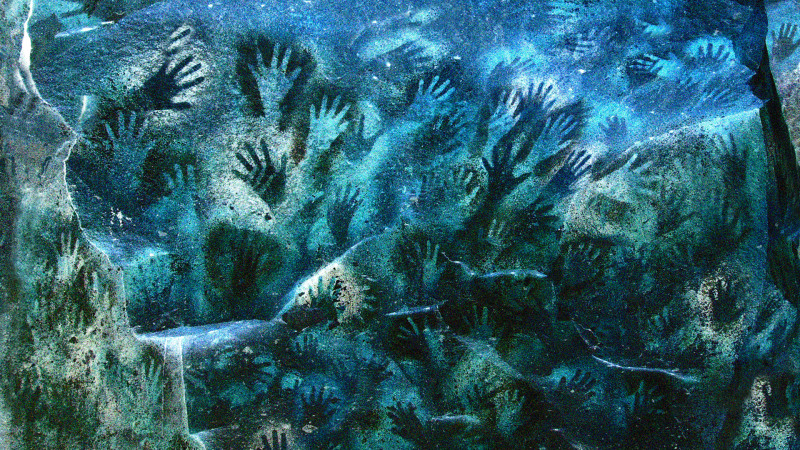
Probably the first major "cultivation" of humans took place around 45,000 years ago. At that time, people began to reflect on their surroundings and their experiences and to abstract them in a creative way - concretely on their cave walls.
My hypothesis is that we as humanity are at a culturally significant point today similar to where we were then. Only the parameters look different:
The painting ground has changed. Our cave wall today is the analog world built by man - in the case of our media artwork in the Old Post Office, the painting ground is the great historical Dominican Court.
Our tools are not fingers, brushes and natural paints, but pixels, bits and bytes that come from the digital universe and are projected onto the analog surface of the Alte Post, where together - the archaic and the futuristic - they create something new.
The motif depicted, however, is the same as it was 45,000 years ago: Namely, what we humans reflect ... where we are right now ... what we see ... what we encounter ... what challenges us. This somehow also gives rise to art. This seems to be fundamental to the human being.
MULTISENSORICS
One difference to archaic cave painting, however, is the multisensory nature of today's media art: "Digital Cave Painting" refers not only to the visual, but in a kind of synesthesia to all sensory channels. What is seen and what is heard are very closely linked, indeed, ideally they should be perceived as one. Other sensory impressions are also interwoven (such as the somatic, olfactory, gustatory) in order to ultimately form moments of an overall sensory experience.
This multisensory overall experience is to be supported by an immersive understanding of space inspired by the archaic cave. In our media artwork in the Alte Post, we understand space as a living organism that can merge with people - similar to the situation in a cave.
Thereby two spaces/two realities start to overlap: the given real space and the artistic virtual space interact - similar to the way the creative mural painting changed the effect of the cave due to the triggered imaginative power of humans.
ARTIFICIAL INTELLIGENCE
In unserem Fall wird es eine KI sein, die in Form komplexer Pixeluniversen versucht, archaische Weltbilder poetisch zu re-konstruieren. Dabei wird die die KI »atmen«, indem sie die Ästhetik zwischen konkret und abstrakt schwanken lässt. Einfluss auf diesen Realtime Prozess wird die feste, historische Architektur nehmen, worauf die digitalen Ströme projiziert werden – und die Menschen, die sich in diesem Hofraum/Höhlenraum bewegen und interagieren können. Real- und Virtualraum interagieren. Die Beziehung Analog-Digital wird in jedem Augenblick neu verhandelt und sinnlich zugänglich gemacht. Zugleich archaisch und futuristisch. Kunst als Wahrnehmungsausdehnung und Bewusstseinserweiterung. Bis ins Heute.
BUT WHERE ARE WE TODAY?
We are standing right now at a next great crossroads, the next, perhaps even the greatest step in humanity's development to date. This step is straddled between two extremes:
On the one hand, there is the integration of the digital into our everyday lives - where artificial intelligence is taking over more and more essential functions in ever more rapid steps and will radically change our lives.
On the other hand, there is the very real and analog environmental crisis of our planet, which is increasingly responding to humanity's hitherto unchecked exploitation of nature.
How can we get a grip on these two dynamized aspects - the completely detached digital of AI and the tangible analog of rapidly increasing global warming?
HUMAN DEVELOPMENT
We are currently standing at this defined interface of human development. But perhaps it is precisely in a new relationship between analog and digital, and in a new relationship between archaic and futuristic, that the approach to solving both challenges lies. As already said: Art as expansion of perception and expansion of consciousness. Into tomorrow.
CHANGE IS COMING
© SHA. 2023