The personal history
As a child I wanted to be an architect – a spatial artist. Then music sounded and captivated me - that's how I became a temporal artist. Years later I was able to soften the boundaries and combine the two: sounds created spaces! Over the years, I became more and more successful at connecting these sound spaces with all other channels of perception. Multisensory rooms were created for holistic experiences. The aim was and is to expand people's perceptual abilities.
A new relationship between the real and virtual world
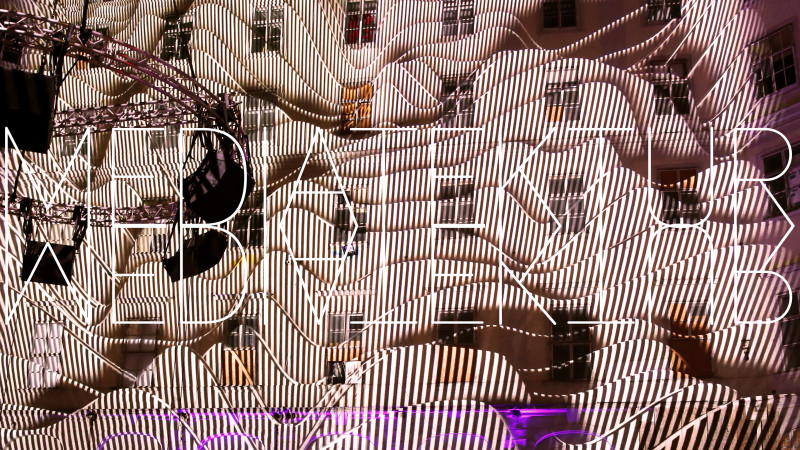
The neologism “Mediatecture” stands for the synergistic connection of media art with architecture. It creates a new relationship between the real and virtual world by confronting the lively and dynamic characteristics of media art with the stability of architecture. In this way, mediatecture expands architecture into a versatile spatial art.
The fusion of architecture and media art – and thus the synergy between the real built world and the virtually projected world – creates a new art form in the so-called “virtureal” space:
For architecture, this means a transformation from a fixed, static, almost eternal character to a dynamic, flowing art form - comparable to music.
For media art, this means a change in its radius of influence: by leaving its protected digital online space and going out of the equally clean and neutral white cube in the museum and penetrating into the often rough, banal and functional everyday life, it becomes a part of everyday life (and thus everyday art).
Art with sociological dramaturgy
However, “everyday capability” demands an additional sociological dimension from media content: In addition to its artistic inspirational power, this content should now also provide a sustainable framework for people’s everyday lives – a role that has traditionally been played by architecture.
To do this, the media content must respond to the analogue location - be "fed" by it by drawing on the space, the time, the environment, the atmosphere, the peculiarities of the situation and, in particular, the people who to enliven and inspire this everyday space. In contrast to the aesthetically neutral white cube in the museum, the physical features of a centuries-old historical facade, for example, cannot be retouched. All that remains is to work with what is there: in mediatecture, what is present/found becomes a resource - the "objet trouvé" becomes an integral part of artistic expression.
The interaction with everyday life is a crucial feature of mediatecture. It emphasizes that mediatecture does not just function as an overlay but is deeply interwoven with the physical and social context: mediatecture creates everyday situations that can connect people in different modes of perception, people in different tempos and people in different spatial dimensions in new, surprising ways.
New challenges for architecture and art
These new tasks for architecture and media art create something third in “virtureal” space, something new that we cannot yet define precisely today:
A social perception experiment
How does our analog experience of space change now that digital worlds have largely colonized our everyday lives?
How have AI, media technologies and media perception already changed our human concepts of space and architecture?
How will architecture react to these changing spatial concepts?
And how will media art change when it takes place in “virtureal” space?
Future vision: alternative uses!
In the coming years, the relationship between built and media public space will fundamentally change. It remains to be seen whether the traditional, analog sensory space will then increasingly become a commercial media space that follows market interests with paid and purchased content (just as the Internet has become).
Or will we – despite or precisely through mediatecture – be able to enable new, free, alternative forms of cultural use in analogue everyday space that are essential for the further development of our society?
© SHA.ART 2024