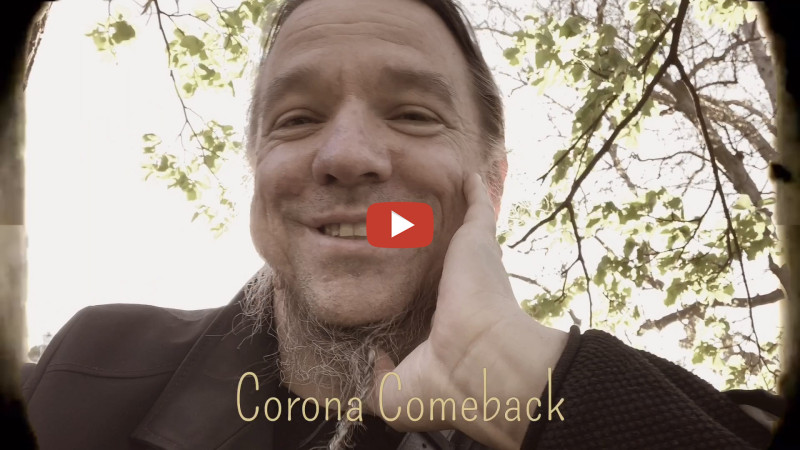
When I look at my one-year-old daughter, I realize that we are equipped with the necessary composure from birth: if a tower of building blocks falls apart, her attention remains on it falling apart. She is neither stuck persevering or even saving the old situation, nor is she stuck preparing or planning a new, ostensibly future situation.
When things fall apart, we can use this dynamic as an opportunity to be open and curious. We can pay attention to what is happening instead of trying desperately to reconstruct the image/concept we had of ourselves. If we succeed in this, we can see opportunities around us, infinite amounts of opportunities. Grasping one or another of them, trying them out, developing them – that takes us out of the crisis and into the flow.
»Change is the only constant in life«
(Heraclitus, Greek Philosopher, 520 BCE)
What can we learn from the crisis?
In Chinese the words »crisis« and »opportunity« share a key ideogram: crisis is translated as weiji 危机, opportunity as jihui 机会. What they both share is the character ji 机, which means an occasion. To take this to an extreme, one could say that the crisis is an occasion for opportunities.
I would like to point out some such opportunities in this text. I will explore »key words«. Which are words that appear to me with particular intensity at this time – words that are the key – words that produce resonance:
1. Mirror
The coronavirus crisis is holding up a mirror that can show your relationship to yourself, to other people, to the whole earth and to the larger systems in which you live. How you are feeling now, what you are afraid of and what you are drawn to, indeed where you are now headed – all that is about you. And this time is sensitively mirroring your inside on the outside.
2. Truth
Lots of facts and aspects of the coronavirus crisis seem to contradict themselves. Both the scientific findings from virology and the assessment of various approaches in the battle against COVID-19 do not seem coherent. The coronavirus crisis’s invitation consists in not always attempting to resolve these contradictions – indeed, not even looking for coherence. Regardless of which of the contradictory narratives about COVID-19 you believe, there is now the opportunity to broaden your horizons to embrace many facets of »truth«.
3. Togetherness
That we now all feel more connected is something that we have heard often over recent months. More obviously than ever before, each of us could – at least intellectually – appreciate how other people’s fate is intertwined with our own. All of creation is a net of closely interconnected relationships. Resonance is the accurate term for this joint sway. Taking this a radical step further, however, this crisis is not only showing us that we are all interconnected parts, but that together we are all one. There is a difference: being connected or being one. Do you know that every thought, every word, every action, that your condition at this moment amounts to everything?
4. Change
At the moment, when our everyday lives have changed involuntarily, many people are experiencing great insecurity, fear and loneliness. What should we do with all these – uncomfortable – feelings? People who have fortitude, as you may have at the moment, are being given a new task by this crisis: »Share what you have. Then it will multiply.« Conscious acts of kindness, the gift of listening, sharing one’s own insights and teaching relaxation methods – all these can be new tasks that will help you and others to get through this time. As Gandhi says: »Be the change you want to see in the world.«
5. Meaning
The crisis has shown us what is really important to us. When your movement is restricted, you have the opportunity to re-examine your life choices, travel habits, your entertainment and your consumption. This also affects the way in which you spend your time, the people with whom you have relationships, the hours you spend on social media, the job you do to earn your so-called livelihood. The crisis has given you the opportunity to see new meanings. It asks you: what is really beneficial to you? What is beneficial to everything? How would you like to spend the precious years that you have in this body? What is really important?
6. Creativity
From Italy’s balcony choirs to the countless webinars, online courses and Zoom meetings that are popping up everywhere – creativity is blossoming worldwide. You could say: humans know how to help each other. To solve unknown problems, alternative methods are now sought. And that’s precisely what humans are made for. The gift of creativity gives us wings! Numerous people suddenly feel motivated to learn things that they had never tried before. They want to share what they know because they believe that it can benefit others. Ironically, isolation seems to lead to a deeper form of solidarity and community. Where do you feel your creative impulse?
7. Gratitude
Many people are already feeling gratitude for things that we had previously taken for granted: a casual stroll in the evening sun, giving a close friend a big hug or simply eating an ice cream carefree amid a crowd of living people. The coronavirus withdrawal is teaching us to revalue the ordinary. Can COVID-19 teach you to lead a grateful life? What speaks for it – and what in you speaks against it? »It is not the happy who are grateful but the grateful who are happy.«
8. Vision
COVID-19 will certainly be a crossroads in human civilization. The crisis is exposing some of our dysfunctional systems. In point of fact, we are right to ask ourselves whether the economic system in which we live is resilient enough if it can collapse this drastically after just a few weeks of unpredictable change. I see two perspectives that come to light: on the one hand, there is the predominantly political paradigm of control, war (»battling the virus«), leadership, power and surveillance. And on the other hand, there are the pluralistic qualities of connectedness, empathy, care and love. Both paths lie before you – which are you drawn to? What is your vision of our future?
9. Good and bad
COVID-19 has shown us that much of what we had before is good – we simply were not able to appreciate it properly. But COVID-19 has also shown us that change is possible: when humanity is united behind a joint cause, rapid change becomes possible in a way that had been inconceivable beforehand. That is fascinating! Just a few months ago, no one would have believed that from one day to the next we humans could permanently ground all global air traffic. Would we?
Summary
Previously we had mainly used the word corona (Latin for wreath or crown) for the fascinating corona of the sun that is only visible to us humans during a total solar eclipse. Perhaps symbolic? There are many things that we humans can only see and acknowledge when they are not there, when they are hidden, or indeed when they are absent.
I see the opportunity for a greater vision of ourselves.
I see the opportunity to write a more sensitive human history.
I see the strength of change.
In return, we are starting to understand that »the system« is not somewhere out there, but that we ourselves are the system. Without doubt, the coronavirus crisis can be a weiji moment for our world:
The crisis is an occasion for opportunities.